

TL;DR
- A cybersecurity audit is a structured review of controls, processes, and evidence against a defined standard or checklist.
- Governance for data security is the framework of policies, roles, and accountability that decides how an organisation protects information.
- Audits generate the evidence that governance needs: they show where controls exist, where they fail, and who owns the fix.
- Regular audits turn governance from a paper policy into something measurable, defensible, and improving over time.
- For regulated businesses, audits also underpin GDPR obligations to keep personal data secure and demonstrate accountability.
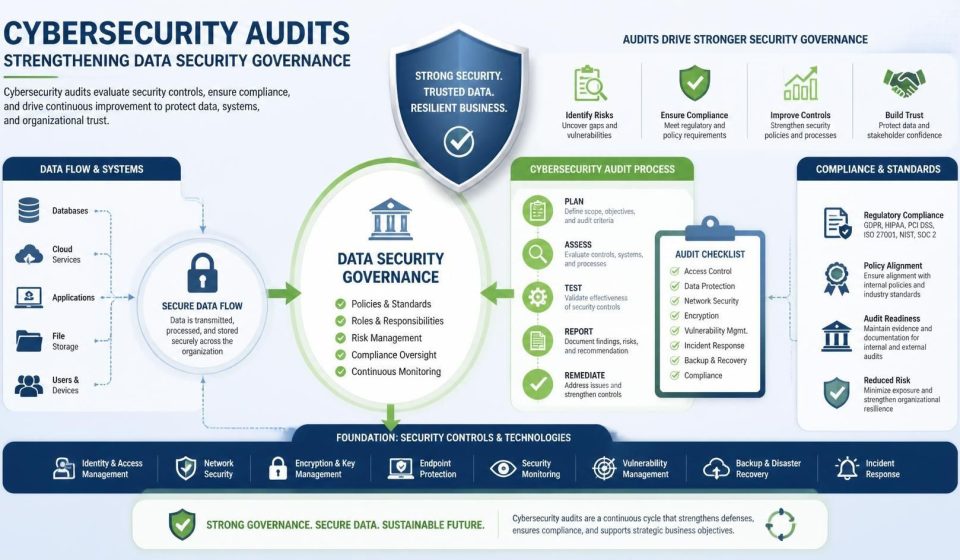
Governance sets the rules for how an organisation protects data. Audits prove whether those rules are actually working. The two are often treated as separate exercises, but they are far more effective when connected. A well-run cybersecurity audit checklist gives governance the one thing it usually lacks: hard evidence about the current state of your controls.
What a Cybersecurity Audit Actually Does
A cybersecurity audit is a structured, repeatable review of your security controls measured against a defined standard, such as ISO 27001, or against an internal checklist. It examines access management, network and endpoint protection, patching, logging, backups, incident response, and third-party risk. The output is not a vague reassurance. It is a documented list of what is in place, what is missing, and how severe each gap is.
The value of a checklist-driven approach is consistency. When the same controls are assessed the same way each cycle, you can compare results over time and see whether your posture is genuinely improving. A one-off penetration test tells you about a moment. A recurring audit tells you about a trajectory, which is exactly what leadership needs to make funding and risk decisions.
What Data Security Governance Provides
Data security governance is the framework of policies, roles, decision rights, and accountability that determines how an organisation protects information. Good data security governance answers practical questions: who owns each dataset, who approves access, what the retention rules are, how risks are escalated, and who is ultimately accountable when something goes wrong. It aligns security activity with business priorities and regulatory duties rather than leaving it to ad-hoc decisions.
The weakness of governance on its own is that it can become theoretical. Policies get written, approved, and filed, then drift away from what teams actually do day to day. Without independent checking, leadership has no reliable way to know whether the framework is being followed. That blind spot is precisely where audits earn their place.
How Audits and Governance Reinforce Each Other
Audits are the feedback loop that keeps data security governance honest. Governance defines the target: the policies, standards, and control objectives the organisation commits to. The audit measures reality against that target and reports the difference. Each finding maps back to a governance owner, a remediation action, and a deadline, which turns an abstract policy into a tracked programme of work.
This relationship also creates a maturity cycle. Governance sets the controls, the audit tests them, findings feed risk decisions, and those decisions refine the next version of the policy. Over several cycles, the organisation moves from reactive fire-fighting to a deliberate, evidence-led posture. Metrics such as the number of open critical findings, time to remediate, and repeat findings across cycles become board-level indicators of whether governance is working.
Third-party risk is where the two disciplines meet most visibly. Governance decides which suppliers may touch your data and under what terms; the audit verifies that those suppliers actually meet the standard you set. Given how much processing now sits with cloud providers and specialist vendors, an audit that stops at your own perimeter leaves a large part of the risk untested. Extending the checklist to cover supplier controls, contractual safeguards, and data-transfer arrangements keeps governance aligned with how work is really delivered.
Why This Matters for Compliance
For any organisation handling personal data, this connection is not optional. The GDPR requires appropriate technical and organisational measures to keep personal data secure, and it requires organisations to demonstrate that accountability, not merely assert it. A documented audit trail, tied to a governance framework, is one of the clearest ways to show a regulator that security is managed rather than assumed.
Running a cybersecurity audit checklist regularly also strengthens breach readiness. When controls are assessed continuously, weaknesses are found and fixed before an attacker exploits them, and incident response plans are tested rather than theoretical. That reduces both the likelihood and the impact of a breach, which is where security spending returns real value.
Making It Work in Practice
The most effective approach treats audits as an integrated part of governance, not a standalone compliance chore. Define your control objectives, assess them against a consistent checklist on a set cadence, assign every finding to an accountable owner, and review progress at leadership level. This rhythm keeps the framework aligned with real risk and gives you defensible evidence at any moment.
It also helps to separate the roles clearly. The people who own and operate a control should not be the only ones assessing it, because independent review is what gives an audit its credibility. Whether that independence comes from an internal audit function or an external specialist, the principle is the same: assurance carries more weight with the board, and with regulators, when it does not simply confirm what the operators already believe.
DPO Consulting helps organisations build this loop, combining compliance audits, CISO-as-a-service, and outsourced privacy oversight so that governance and assurance stay connected rather than siloed. To see where your controls stand today, request a cybersecurity and compliance audit with DPO Consulting and receive a prioritised remediation roadmap mapped to your governance framework.