
If you have ever pressed keys during a phone call to navigate a menu, enter an account number or confirm a payment, you have used DTMF. Dual-tone multi-frequency signaling, better known as touch-tone dialing, is the system that turns each key press on a telephone keypad into a distinctive pair of tones. Those tones travel over the phone line and tell the receiving system exactly which key you pressed.
Although DTMF dates from the 1960s, it remains widely used in telephony, call centers, banking, voicemail and interactive voice systems. This guide explains what DTMF is, how it works, why it was designed the way it was, and where it is used today, including its security implications.
What Is DTMF?
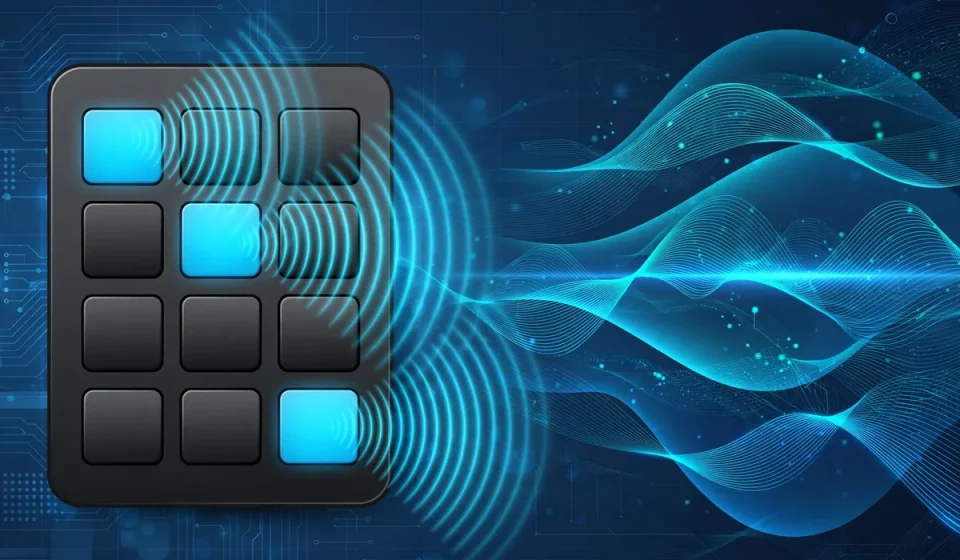
DTMF stands for dual-tone multi-frequency. Each key on a telephone keypad generates two simultaneous tones: one from a low-frequency group and one from a high-frequency group. The combination is unique to that key, so a receiver that can identify the two frequencies can determine which key was pressed, even over a noisy line.
The standard keypad has four rows and four columns, although most phones show only three columns plus the 0, star and hash keys. Rows use low frequencies of 697, 770, 852 and 941 hertz, while columns use high frequencies of 1209, 1336, 1477 and 1633 hertz. Pressing 1, for example, combines 697 Hz and 1209 Hz, while pressing 9 combines 852 Hz and 1477 Hz. The star and hash keys use the same scheme, and the fourth column, with keys A, B, C and D, is used mainly in specialized military and network control applications.
How Touch-Tone Signaling Works
When you press a key, the phone generates the two tones for a short duration, typically at least 40 milliseconds, with a gap before the next key. The tones travel in-band, meaning they use the same audio channel as your voice, over the phone network to the receiving system. A DTMF decoder analyzes the incoming audio, identifies the two frequencies present, and maps them back to a key.
Using two tones, rather than one, makes the system robust. A single tone could be confused with speech, music or background noise, but the chance that ordinary voice contains both a specific low and high frequency at the right levels for the right duration is much lower. Decoders also check tone duration, level and the absence of other strong tones, further reducing false detections. This design allowed touch-tone signaling to work reliably over the analog telephone network long before digital signaling became common.
DTMF vs. Older Pulse Dialing
Before touch-tone, rotary phones used pulse dialing: dialing a digit sent a series of electrical pulses, one per unit of the digit, which the exchange counted. Pulse dialing was slow, especially for long numbers, and it could not send signals during a call, only to establish one. DTMF changed both: keys could be pressed quickly, and tones could be sent at any point during a call, enabling menus, remote control and data entry after connection.
Modern telephony has largely moved to digital signaling for call setup, using protocols such as SIP, but DTMF tones are still carried, often as separate digital events or as audio, so that interactive systems continue to work across old and new networks. That backward compatibility is a major reason DTMF has survived for so long.
DTMF Keypad Frequencies
| Key | Low Frequency (Hz) | High Frequency (Hz) | Common Use |
|---|---|---|---|
| 1 | 697 | 1209 | Menu option 1 |
| 2 | 697 | 1336 | Menu option 2, ABC |
| 5 | 770 | 1336 | Menu option 5, JKL |
| 9 | 852 | 1477 | Menu option 9, WXYZ |
| 0 | 941 | 1336 | Operator, often 0 |
| * | 941 | 1209 | Special commands |
| # | 941 | 1477 | Confirm, end input |
Notice the pattern: each row shares a low frequency and each column shares a high frequency, so only the pair identifies the key. This matrix design is elegant, efficient and easy to implement in both hardware and software, which helped DTMF become a global standard.
Uses of DTMF Today
Interactive voice response (IVR)
Call centers and service lines use DTMF for IVR menus: press 1 for sales, 2 for support, and so on. Customers can navigate services without speaking to an agent, and systems can route calls, collect information and authenticate callers before an agent is involved.
Voicemail, banking and payments
Voicemail systems use DTMF to play, save, delete and forward messages. Banks and payment services use it for telephone banking, card activation and payment confirmation, where customers enter account numbers, PINs and amounts using the keypad.
Remote control and conferencing
DTMF controls conference calls, muting, recording and participant management, and it is used to control remote equipment, gates and industrial systems where a phone call is a convenient control channel. It is also used in amateur radio and emergency communications for repeater control and signaling.
Two-factor and verification
Some verification systems use DTMF as part of phone-based authentication, for example pressing a key to confirm a transaction during a call. While app-based and hardware-based authentication are generally stronger, DTMF remains a fallback where smartphones or data connections are unavailable.
DTMF in Modern VoIP and SIP Networks
In Voice over IP networks, DTMF must survive a journey that was never designed for analog tones. Voice codecs compress audio to save bandwidth, and that compression can distort DTMF tones so badly that a decoder at the far end fails to recognize them. To solve this, VoIP systems commonly carry DTMF out of band, using SIP INFO messages or RFC 2833 and RFC 4733 telephone events, which transmit the key press as a digital event rather than as audio. This approach is far more reliable than sending tones through a compressed voice channel, and it allows IVR and banking systems to work consistently across internet telephony.
Interoperability remains a practical challenge. Different providers, gateways and phone systems may use different DTMF transport methods, and a mismatch can cause key presses to be lost or duplicated. When deploying VoIP, engineers should test DTMF end to end with each provider and device type, confirm which transport method is negotiated, and monitor IVR completion rates after changes. A system that works in a lab but fails with a particular carrier in production is a common and frustrating problem, so testing with real carriers matters.
Security Considerations
DTMF tones are not secret by design. Because they travel as audio, they can be overheard, recorded or intercepted if a call is not encrypted. Entering a PIN, password or card number via DTMF on an unencrypted or poorly secured call can expose sensitive data to anyone who can hear or record the call, including shoulder surfers, call recording systems and network attackers.
Best practice is to avoid entering highly sensitive information via DTMF unless the call is encrypted and the receiving system is trusted, to use DTMF only for low-risk navigation where possible, and to prefer stronger authentication methods for high-value transactions. Organizations that collect DTMF input should protect recordings, limit retention, mask sensitive digits in logs, and comply with payment and privacy regulations that govern recorded calls.
Telephony signaling also connects to wider network security. For how network traffic is inspected and protected, see this guide to what packet capture is and how it works. Perimeter controls for voice and data networks are covered in this explanation of what a network firewall does, and for the facilities that host modern telephony platforms, see what data centers are and how they work.
Frequently Asked Questions
What does DTMF stand for?
DTMF stands for dual-tone multi-frequency, the signaling system that represents each telephone keypad key as a pair of simultaneous tones.
How does DTMF work?
Each key generates one low-frequency tone and one high-frequency tone. A decoder identifies the pair and maps it back to the key that was pressed.
Why are two tones used instead of one?
Two tones make detection reliable and resistant to false triggers from speech or noise, because ordinary voice rarely contains both specific frequencies together at the right levels.
Is DTMF still used today?
Yes. DTMF remains widely used for IVR menus, voicemail, banking, conferencing and remote control, even as call setup has moved to digital signaling protocols.
Is entering a PIN by DTMF safe?
It can be risky on unencrypted calls, because tones can be overheard or recorded. Use encrypted calls and trusted systems, and prefer stronger authentication for high-value transactions.



[…] Most systems use a mix: DTMF for numbers and account codes, speech for names and open questions, and AI for the most common requests. The tone system behind DTMF is explained in our guide to DTMF: how touch-tone signaling works. […]