
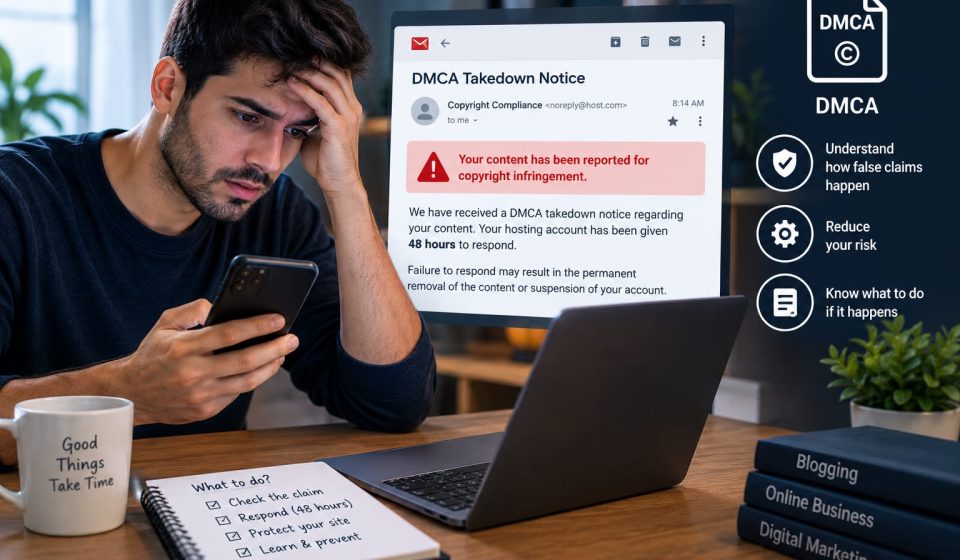

What Is DMCA Claim, and Why Do False Ones Happen?
A DMCA takedown notice is a formal request, sent to a website owner or hosting provider, asking for allegedly infringing content to be removed.
The process comes from Section 512 of the US Copyright Act and is built around a “notice and takedown” idea: when a host receives a valid notice, it usually removes or disables the content quickly to protect itself from liability.
That speed is the weakness. Because hosts tend to act first and ask questions later, a baseless notice can take your page offline before anyone checks whether it is valid.
Common Reasons False Claims Are Filed
Not every bad claim is malicious. In practice, false or mistaken notices usually come from a handful of sources:
- Automated detection tools that match text, images or audio and flag content without understanding context, licences or fair use.
- Competitors trying to knock a rival page out of search results or disrupt a product launch.
- Copyright trolls who send mass notices hoping some recipients will pay a settlement rather than fight.
- Honest mistakes, such as someone confusing your original work with a copy they found elsewhere.
- Reputation attacks, where a critical review or news article is targeted simply because someone wants it gone.
Why It Matters More?
Content volume keeps growing, and so does the use of automated enforcement. More scanning means more false positives, which is why website owners can no longer treat DMCA readiness as an afterthought.
How to Spot a Questionable DMCA Notice?
Before reacting, read the notice carefully. A legitimate notice must include specific elements: identification of the copyrighted work, the exact location of the allegedly infringing material, the complainant’s contact details, a good-faith statement, and a statement under penalty of perjury that the information is accurate and that the sender is authorised to act.
Be suspicious if you notice any of the following:
- The notice is vague and does not name the original work.
- The URL points to content you created yourself or properly licensed.
- The sender is unwilling to identify themselves or uses a free email account with no verifiable company.
- The notice demands payment instead of removal.
- The claim targets commentary, criticism, news reporting or parody, which often fall under fair use.
A notice with missing elements is not automatically void, but it gives you a strong starting point when you respond.
Prevention: Build Your Defences Before You Need Them
The best response to a false claim is evidence you collected long before it arrived. A few habits make a big difference.
Keep Proof of Original Creation
Save drafts, source files, raw photos, design files and publishing timestamps. If someone claims you copied them, being able to show that your file existed first can end the dispute quickly. Cloud storage with version history, Git repositories and your CMS revision history are all useful here.
Document Every Licence
Keep a simple spreadsheet or folder with licence receipts for stock images, fonts, music, themes and plugins.
Watch Your Third-Party Assets
Free templates and bundled plugins sometimes include media with unclear licensing. Check the licence terms before publishing, and keep a copy of the page showing those terms, since they can change or disappear later.
Understand Fair Use
Quoting a short passage for review, commentary or education, with proper attribution, is often protected as fair use. Courts look at the purpose of the use, the nature of the original, how much was used and the effect on the market. Fair use is a case-by-case question, so do not assume it applies, but do learn the basics so you can recognise when a claim ignores it.
Add Clear Copyright and Contact Information
A visible contact page and copyright notice make it easier for genuine rights holders to reach you directly. Many disputes get resolved with a polite email before a formal takedown ever happens. If your site hosts user-generated content, also consider registering a designated DMCA agent with the US Copyright Office to keep your own safe-harbor protections in place.
What to Do the Moment You Receive a Notice
Stay calm and move methodically. Rushed replies cause more harm than slow ones.
Step 1: Read, Save and Verify
Save the notice and every related email. Check the claimed work, the URLs and the sender’s details. Compare the claimed original against your content and your records.
Step 2: Talk to Your Host
Most hosting providers have a process and a deadline. Reply quickly, confirm you have received the notice and explain that you are reviewing it. Silence is the fastest way to get your account suspended.
Step 3: Decide Whether to Remove, Negotiate or Dispute
If the claim is partly valid, such as one image you forgot to license, removing that item may be the cleanest fix. If the claim is clearly wrong, you can challenge it with a counter-notice.
Step 4: File a Counter-Notice if the Claim Is False
A counter-notice is your formal reply, asking for the content to be restored.
What a Counter-Notice Usually Includes
- Your physical or electronic signature.
- Identification of the removed material and where it appeared.
- A statement under penalty of perjury that you believe the material was removed by mistake or misidentification.
- Your name, address and phone number, and consent to the jurisdiction of the relevant federal court.
Once a valid counter-notice is delivered, the complainant generally has around 10 to 14 business days to file a court action. If they do not, the host can restore the content. Because the counter-notice is made under penalty of perjury and involves court jurisdiction, take it seriously and get legal advice if the stakes are high.
When to Hire a Lawyer
If the claim involves a large revenue-generating page, repeated notices, a settlement demand or threats of a lawsuit, speak to an attorney. An hour of legal advice is usually cheaper than losing a business-critical page.
Holding Bad-Faith Claimants Accountable
The law does include a safeguard. Section 512(f) states that anyone who knowingly makes a material misrepresentation in a takedown notice can be liable for damages. Courts have also said that copyright owners must consider fair use before sending a notice. Pursuing such a claim can be expensive, so it is mostly a last resort, but knowing that the rule exists can strengthen your position when you respond.
Why Your Hosting Provider Makes a Difference?
Many website owners overlook this part. When a notice arrives, your host is the one deciding how fast to act and how much room you get to respond. Some providers suspend a site almost immediately; others give you time, share the notice in full and let you present your side.
Jurisdiction also matters. The DMCA is a US law, and hosts operating under other legal systems follow their own rules. In the European Union, for example, hosting providers work within frameworks such as the Digital Services Act, which sets its own notice-and-action procedures.
That doesn’t mean valid legal claims are ignored, but it does mean the process is structured differently, with attention to proper evidence and due process. For a legitimate site facing questionable claims, a transparent host in a privacy-conscious jurisdiction can be a real advantage.
Secure Your Website with QloudHost
If you want a hosting partner built with takedown-risk in mind, QloudHost is worth a look. QloudHost offers DMCA Ignored hosting and offshore web hosting from its Tier III data center in Amsterdam, Netherlands, giving websites a stable, enterprise-grade infrastructure in a strong privacy jurisdiction.

Here is a quick overview of what you can expect:
- DMCA secure hosting: hosting designed for website owners who want a fair, evidence-based process when complaints arise, rather than instant suspension.
- Offshore hosting: infrastructure outside the United States, suited to businesses, publishers and creators who value privacy and data protection.
- Tier III Amsterdam data center: high availability and redundancy to keep your site online.
- DirectAdmin by default: a fast, lightweight control panel on its plans, with cPanel available on request if you prefer it.
QloudHost is intended for legitimate websites, and customers remain responsible for keeping their content lawful. If you run a blog, store, news site or agency and want more breathing room when a questionable claim appears, explore the plans at QloudHost.
Frequently Asked Questions
Can someone really take my website down with a fake DMCA notice?
Yes, a false notice can lead a host to disable your content quickly, even before the claim is checked. That is why keeping records and responding promptly matters. A counter-notice is the formal route for getting content restored.
Is filing a false DMCA claim illegal?
Knowingly making a material misrepresentation in a notice can create liability under Section 512(f) of the DMCA. Proving it can be difficult and costly, so it is typically reserved for clear cases of abuse.
How long does a counter-notice take to work?
After a valid counter-notice, the claimant generally has about 10 to 14 business days to start a court action. If they do not, the host may restore the content. Timelines can vary by provider.
Does fair use protect my content automatically?
No. Fair use is decided case by case, based on purpose, amount used and market effect. Commentary, criticism and education often qualify, but you should not assume it without checking.
Does the DMCA apply to websites hosted outside the US?
The DMCA is US law, so it does not directly bind every host worldwide. Hosts abroad follow local laws, though valid legal claims are still handled under those rules. Your content must also comply with the laws that apply to you.
Conclusion
False DMCA claims are frustrating, but they don’t have to be devastating. Keep proof of your original work, document your licences, learn the basics of fair use, and respond to every notice quickly and carefully.
When a claim is wrong, a well-prepared counter-notice gives you a legitimate way to fight back, and a good hosting provider makes the whole process easier.
Prepare now, and the next suspicious email will be an inconvenience instead of a crisis.