

In cyber security, the blue team is the defence. While attackers try to break in, the blue team builds the walls, watches the gates, detects intrusions and responds when something gets through. Every organisation with a serious security programme has a blue team — whether it is a dedicated team of twenty or a single engineer wearing many hats. Understanding what the blue team does, the roles inside it, the tools it uses and how it differs from the red team is essential for anyone building a career in defence.
This guide explains the blue team in cyber security: its mission, its day-to-day work, its roles and tools, how blue and red teams work together, and how to join a blue team yourself.
What Is a Blue Team in Cyber Security?
A blue team is the group responsible for defending an organisation’s information systems. The name comes from military exercises, where the defending force was traditionally marked in blue and the attacking force in red. In cyber security, the blue team owns the defensive side: it designs secure systems, monitors for attacks, investigates suspicious activity, responds to incidents, and continuously improves defences based on what it learns.
The blue team works inside the organisation it protects. Unlike the red team, which attacks from the outside, the blue team knows the network, the systems, the users and the business. Its job is not to find a single vulnerability — it is to keep the whole environment secure against every kind of attack, all of the time. That makes it a broader and more continuous job than offensive testing: a red team engagement lasts weeks, but the blue team defends every day.
Blue teams exist in many forms. A large enterprise may have a Security Operations Centre (SOC) working around the clock, a separate incident response team, and dedicated detection engineers. A small company may have one or two people doing all of it, supported by a managed security service provider. The mission is the same at any size: prevent what you can, detect what you cannot prevent, and respond fast when something happens.
What Does a Blue Team Do?
The blue team’s work falls into five areas, often called the defensive cycle:
- Protect: Harden systems, manage patches, configure firewalls and access controls, and segment networks so that a breach in one place cannot spread everywhere.
- Detect: Monitor logs, alerts and network traffic for signs of attack, and tune detection rules so that real attacks stand out from the noise.
- Respond: Investigate alerts, contain incidents, remove attackers, and restore affected systems — then learn from the incident.
- Recover: Restore services from clean backups, verify the environment is safe, and bring the business back to normal operations.
- Improve: Turn every incident, every red team exercise and every new threat into better detection, better hardening and better playbooks.
On a typical day, a blue team analyst starts by reviewing overnight alerts, checks whether any new vulnerabilities affect the organisation’s systems, works on a detection rule for a technique seen in a recent attack, and helps a colleague investigate a suspicious login. The work is a mix of routine monitoring and deep investigation, and it changes every day because the attackers change every day.
Blue Team Roles
A blue team is not one job — it is a set of roles that work together. In a large team, each role is a separate position; in a small team, one person covers several.
| Role | Main responsibility | Typical experience |
|---|---|---|
| SOC analyst | Monitoring alerts and triaging incidents around the clock | Entry level — the classic first security job |
| Incident responder | Leading the response to confirmed attacks and breaches | 3–5 years, often from the SOC |
| Detection engineer | Writing and tuning detection rules for SIEM and EDR | 2–5 years, strong log and query skills |
| Security engineer | Building and maintaining security tools and controls | 3–5 years, systems and automation skills |
| Threat intelligence analyst | Studying attackers and turning intelligence into defence | 2–5 years, analytical and research skills |
| Vulnerability analyst | Finding, prioritising and tracking vulnerabilities | 1–3 years, scanning and patching knowledge |
| IAM engineer | Managing identities, access and authentication | 2–5 years, directory and access expertise |
| Blue team lead / SOC manager | Running the team, setting priorities, reporting to leadership | 5+ years, leadership and communication |
The SOC analyst role is where most blue team careers begin. It teaches the fundamentals — logs, alerts, networks, triage — that every other defensive role builds on. From there, analysts specialise in detection, incident response, threat intelligence or engineering, depending on their interests.
Blue Team Tools
Blue teams rely on a layered set of tools. No single tool defends an organisation; the strength comes from combining them so that an attacker must defeat several layers at once.
| Category | Examples | What it does |
|---|---|---|
| SIEM | Splunk, Microsoft Sentinel, Elastic | Collects logs and alerts on suspicious patterns |
| EDR / XDR | CrowdStrike, SentinelOne, Defender | Monitors endpoints and blocks or isolates threats |
| Firewall and network security | Palo Alto, Fortinet, pfSense | Controls traffic between networks |
| IDS / IPS | Snort, Suricata, Zeek | Detects and blocks network intrusions |
| Vulnerability scanner | Nessus, Qualys, OpenVAS | Finds known vulnerabilities in systems |
| SOAR | Cortex XSOAR, Splunk SOAR | Automates repetitive response tasks |
| Threat intelligence platform | MISP, Recorded Future, Anomali | Manages indicators and threat data |
| Identity and access | Entra ID, Okta, CyberArk | Controls who can access what |
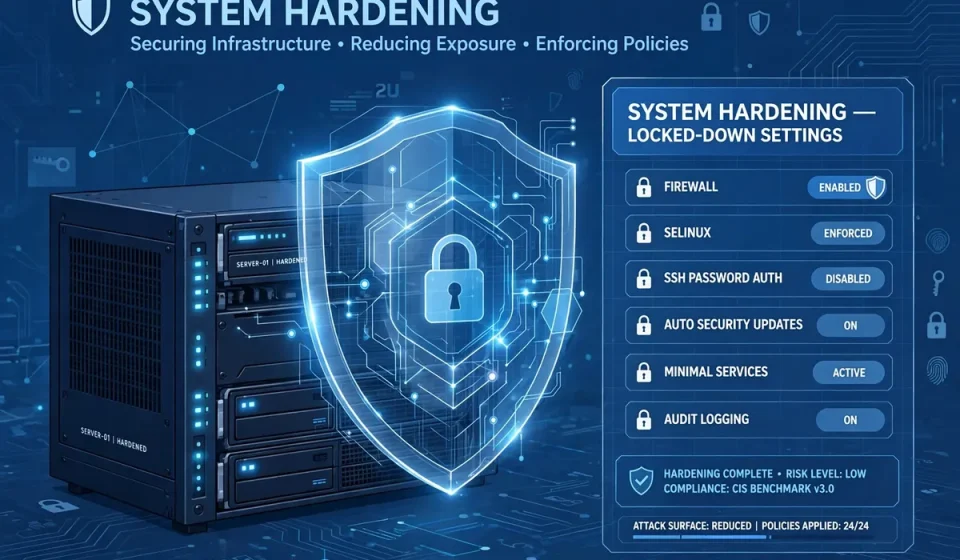
Two of the most important blue team disciplines deserve special attention. The first is hardening — the systematic work of making systems secure by default. Our guide to system hardening explains the process in detail. The second is access control: most breaches involve stolen or misused credentials, so getting identity right is a defensive priority. Our guide to RBAC meaning: what role-based access control is explains the access model blue teams use most often.

Blue Team vs Red Team
The red team is the blue team’s counterpart: a group that simulates real attackers to test the organisation’s defences. The two teams have opposite jobs, different skills and different measures of success — but they exist to make each other better.
| Aspect | Blue team | Red team |
|---|---|---|
| Mission | Defend the organisation | Attack the organisation (with permission) |
| Approach | Continuous, always on | Time-limited engagements |
| Knowledge | Knows the environment inside out | Starts with limited knowledge, like a real attacker |
| Success means | Attacks blocked, detected and contained | Finding a realistic path to the objective |
| Main skills | Monitoring, detection, incident response, hardening | Exploitation, evasion, social engineering, persistence |
| Tools | SIEM, EDR, firewalls, scanners | Exploitation frameworks, custom tooling, phishing kits |
| Typical background | IT support, SOC, systems administration | Penetration testing, software development, security research |
The comparison is sometimes confused by a third colour: the purple team. A purple team is not a separate group — it is the collaboration between red and blue. In a purple team exercise, the red team attacks openly, the blue team watches in real time, and both sides work together to improve detection and response. Purple teaming is the fastest way to close defensive gaps, because the blue team sees exactly which techniques its controls missed and can fix them the same day.
How Blue and Red Teams Work Together
A healthy security programme runs a cycle. The red team (or an external penetration testing firm) tests the defences and reports what it could reach. The blue team fixes the gaps — a new detection rule, a patched vulnerability, a changed firewall policy, a better playbook. Then the red team tests again. Over time, the attacks that used to succeed are blocked or detected in minutes, and the red team has to work harder to find a way in. That is the whole point: the exercise is not a competition, it is a measurement of defensive maturity.
To make this work, the two teams must share information after each exercise — what the red team did, what the blue team saw, and what neither side noticed. Findings should be tracked like any other security work, with owners and deadlines. An exercise whose findings are never fixed is worse than no exercise at all, because it creates a false sense of security.
Blue Team Skills and Certifications
Defensive work rewards breadth. A good blue team analyst understands networks, operating systems, cloud platforms, identity and the attacker’s mindset — and can explain a technical risk in plain language to a manager.
- Core knowledge: Networking (TCP/IP, DNS, HTTP), Windows and Linux administration, Active Directory, and cloud fundamentals.
- Detection: Reading logs, writing SIEM queries, and understanding how attacks appear in telemetry.
- Incident response: Triage, containment, eradication and recovery — and the discipline of documenting everything.
- Scripting and automation: Python and PowerShell for automating triage, enrichment and response.
- Vulnerability management: Finding and prioritising weaknesses. Our guide to define vulnerability: what it means in cyber security is a good starting point for the terminology.
- Communication: Writing incident reports and briefings that non-technical people can act on.
Certifications that employers look for include CompTIA Security+ and CySA+ for entry-level roles, GIAC GCIH for incident handling, GIAC GCDA for detection, and CISSP for senior and management roles. Hands-on experience — a home lab, a SIEM with real logs, a detection rule you wrote yourself — counts for at least as much as a certificate.
How to Join a Blue Team
- Learn the fundamentals. Networking, operating systems and security basics. A home lab with a virtual network, a SIEM and a few virtual machines is the best classroom.
- Get an entry-level IT or SOC role. Help desk and network administration experience teach you how real systems work — and how they break.
- Earn a foundation certification. CompTIA Security+ is the standard starting point, followed by CySA+ for defensive analysis.
- Build a portfolio. Write up a detection you built, an incident you investigated in your lab, or a hardening guide you followed. Publish it — hiring managers notice.
- Apply for SOC analyst roles. That is the front door to blue team work. From there, specialise in detection, incident response, threat intelligence or engineering.
- Keep learning. Study real incident reports, follow threat research, and practise in exercises such as capture-the-flag events for defenders.
Example: A Blue Team Stops a Phishing Attack
A realistic example shows the blue team cycle in action. At 9:00 a.m., an employee reports a suspicious email. The SOC analyst checks the email gateway logs and finds that the message reached 40 mailboxes; five people clicked the link. The detection engineer writes a rule to find any device that contacted the phishing domain, and the EDR isolates two workstations that did. The incident responder confirms that no malware ran and no credentials were entered, resets the passwords of the five users as a precaution, and blocks the domain at the firewall and the email gateway. The threat intelligence analyst adds the domain and the sender’s infrastructure to the team’s watchlist and checks whether the same campaign is targeting other companies in the sector. The next day, the team runs a short phishing awareness reminder for the whole company. The attack failed — and the defences are stronger than they were the day before.
Frequently Asked Questions
What is the difference between blue team and SOC?
The SOC is part of the blue team. The blue team is the whole defensive function — SOC, incident response, detection engineering, vulnerability management and security engineering. The SOC is the team that monitors alerts and responds first, usually around the clock.
Is blue team harder than red team?
They are hard in different ways. The red team must find one path in; the blue team must defend every path, all the time. Blue team work is broader and more continuous, while red team work is deeper and more specialised. Many security professionals try both over a career.
Do blue teams hack?
Blue teams do not attack their own organisation — that is the red team’s job. Blue team members do need to understand hacking techniques, because you cannot detect an attack you do not understand. Many blue team analysts practise offensive skills in labs and capture-the-flag events.
What is a purple team?
A purple team is the collaboration between the red team and the blue team during an exercise. The red team attacks openly while the blue team observes and tunes its defences in real time, so both sides improve together.
Can I join a blue team without a degree?
Yes. Employers value practical skills, certifications and demonstrated experience — a home lab, a portfolio, SOC experience — more than a degree. Many blue team analysts come from IT support or systems administration.
Conclusion
The blue team is the defence of cyber security: the people who harden systems, watch for attacks, respond to incidents and turn every lesson into a stronger defence. It is broad, continuous and deeply practical work, and it is where most security careers begin. The red team exists to test the blue team, and the purple team brings them together — but the blue team is the one that has to be right every day. If you want to protect organisations rather than attack them, build the fundamentals, get into a SOC, learn detection and incident response, and start defending.



[…] and security, rather than checking five separate consoles. Telemetry is also what makes a blue team effective: defenders cannot defend what they cannot see, and telemetry is how they see […]
[…] of finding and fixing these weaknesses is central to the defensive role described in our guide to what a blue team is and what it […]