

1. The Deployment Paradox: Why More Code Leads to Slower Shipping
The Architecture of the Code-Velocity Wall: How Manual Verifications Strangle Innovation
Engineering departments frequently face a frustrating barrier where writing code outpaces the ability to verify it. Manual quality checks create a massive operational bottleneck that completely stalls modern continuous deployment pipelines. As shipping schedules compress, relying on human test execution forces teams to choose between speed and system stability.
The Compound Interest of Technical Debt: What Unchecked Micro-Bugs Cost Your Timeline
Defects that escape and end up in production serve as a high-interest loan against future development rounds. Planned product roadmaps are derailed by small, unfixed coding flaws that quickly build over time and require costly, urgent hotfixes. Without strong, automatic review, engineers spend more time fixing previous mistakes than building novel, cutting-edge features.
2. Structural Metamorphosis: Redefining “Software Testing” inside the CI/CD Pipeline
Beyond the Safety Net: Moving from Reactive Bug Hunting to Predictive System Auditing
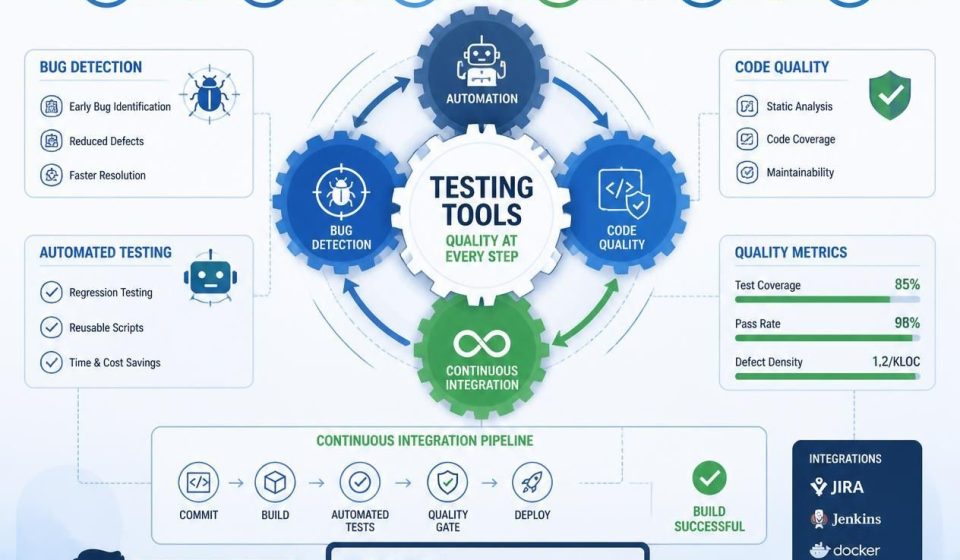
Modern engineering teams no longer view software testing as a final, isolated phase before a product launch. Instead, elite organizations use automated validation engines to audit system health dynamically with every individual code commit. This continuous oversight transforms quality operations from basic reactive error detection into a highly predictive system safeguard.
Orchestrating Cognitive Offloading: Letting Automated Suites Manage the Burden of Regression
Forcing human engineers to manually run hundreds of repetitive regression scripts strips away valuable creative problem-solving energy. Modern digital verification platforms handle these boring, repetitive checks automatically, validating complex workflows across diverse browser environments. This comprehensive automation offloads intense cognitive burdens, letting your core team focus exclusively on building impactful architecture.
The Shift-Left Reality Check: Embedding Verification into the First Line of Code Written
Waiting until an application is fully compiled to check for critical flaws drastically inflates eventual patch costs. True development transformation relies on shift-left methodologies that execute unit and API validations immediately during the authoring phase. Embedding software testing directly into early workflows allows developers to identify and resolve logic flaws instantly.
3. The Selection Taxonomy: Auditing Software Testing Tools for Elite Performance
Interoperability vs. Isolation: Ensuring Your Testing Framework Native-Links with Core IDEs
Isolating your quality assurance framework from core engineering environments creates extreme frictional drag across the organization. Teams must evaluate software testing tools based heavily on their ability to integrate directly with existing repository workflows. Seamless IDE and issue-tracker data syncing ensures that bug documentation reaches the responsible developer without any delay.
Algorithmic Self-Healing: Selecting Ecosystems That Automatically Re-Script Brittle Selectors
Conventional UI automation scripts are notably brittle and often break when a small front-end layout change takes place. Intelligent software testing tools that use complex, low-code machine learning methods to automatically fix broken locators are a top goal for forward-thinking businesses. This smart feature totally removes the need for hard human script maintenance, ensuring that your automatic processes continue to function perfectly.
Observability Layers: How Advanced Telemetry Drastically Cuts Down Mean Time to Resolution (MTTR)
Complex software infrastructure problems cannot be addressed with a simple pass or fail notice because it lacks sufficient technical context. Extensive tracking data, such as complete network logs, computer outputs, and step-by-step video playbacks, is recorded by top-tier software testing tools. Engineering teams may quickly find the source of execution mistakes thanks to this thorough observability, which significantly lowers the average time to resolution.
4. The Human Dividend: Eradicating Developer Burnout and Friction
Breaking the Silo: Transforming QA from a Blame-Engine into an Enablement Hub
In a pointless loop of blame, standard development processes frequently put engineers against separate quality assurance teams. By giving a clear, shared source of truth for all parties, modern automatic validation tools remove this complexity. This collaborative transparency shifts organizational culture, transforming quality teams into crucial partners that help accelerate product shipping.
Reclaiming Creative Engineering Time by Automating Predictable, Repetitive Verification Cycles
Developer burnout frequently stems from spending endless hours manually checking database migrations and repetitive user interface fields. Automating these predictable execution flows allows organizations to hand back hours of focus time to their technical staff. Reclaiming this vital mental bandwidth boosts overall developer satisfaction and directly accelerates the launch of competitive features.
5. Conclusion: Weaponizing Quality as a Competitive Shipping Advantage
Adopting the right digital infrastructure completely changes how an enterprise handles system reliability and software deployment velocity. Deploying advanced software testing tools allows businesses to eliminate historical deployment bottlenecks and ship stable code with complete confidence. Ultimately, embedding intelligent automation into your core pipeline turns product quality into an elite, scalable market advantage.