
IT and OT are two worlds that used to live apart. Information technology ran the office: email, laptops, databases and the corporate network. Operational technology ran the plant: the machines, sensors, controllers and industrial systems that make things, move power and treat water. Today those worlds are connected — and that connection is where the biggest cyber security challenges in industry now live.
This guide explains IT vs OT in plain language: what each one is, the key differences, where they overlap, and how to secure them now that they share a network.
What Is IT (Information Technology)?
Information technology is the technology used to create, store, exchange and manage business data. It covers the systems most people think of as “computers”: laptops and desktops, servers, email, databases, enterprise software such as ERP and CRM, cloud services, and the corporate network that connects them.
IT’s purpose is to process information. Its priorities are the classic CIA triad: confidentiality (keeping data private), integrity (keeping data accurate) and availability (keeping systems running). IT systems change fast — software is updated weekly, hardware is replaced every few years, and a system can be rebooted for a patch with little notice. The IT team measures success in uptime, response time and user satisfaction.
What Is OT (Operational Technology)?
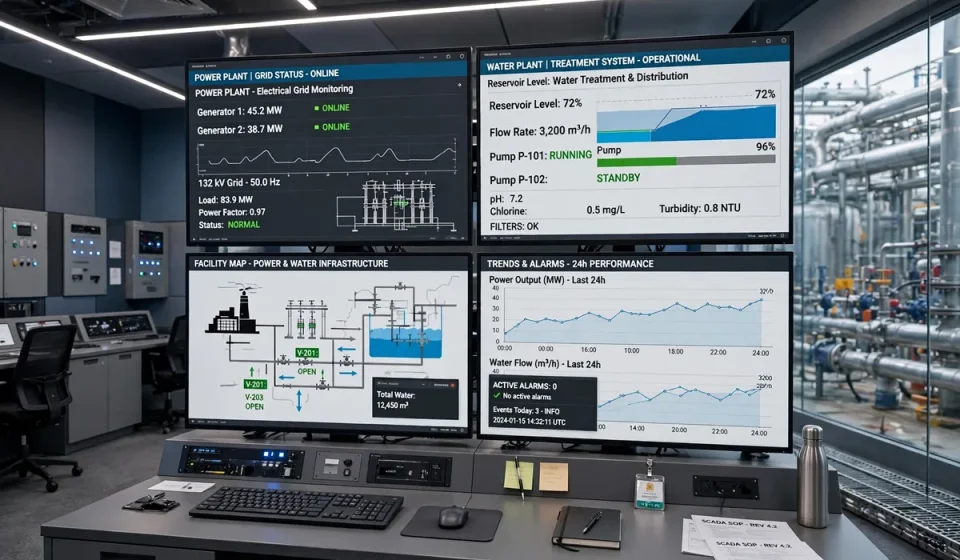
Operational technology is the hardware and software that monitors and controls physical devices and industrial processes. It includes SCADA systems, programmable logic controllers (PLCs), distributed control systems (DCS), sensors, actuators, industrial robots and the human-machine interfaces that operators use to run a plant.
OT’s purpose is to control the physical world. Its top priority is safety, followed by availability and then integrity — a different order from IT. A failure in OT can injure people, damage equipment, stop production or disrupt a public service such as electricity or water. OT systems change slowly: a controller installed twenty years ago may still be running the plant, with software that cannot be patched without a planned shutdown. Rebooting an OT system is not a routine task — it is a maintenance event that stops production.
IT vs OT: Key Differences
| Aspect | IT | OT |
|---|---|---|
| Purpose | Process and manage information | Monitor and control physical processes |
| Examples | Laptops, email, ERP, cloud, databases | SCADA, PLCs, sensors, robots, HMIs |
| Top priority | Confidentiality, then integrity, then availability | Safety, then availability, then integrity |
| System lifetime | 3–5 years | 15–30 years |
| Patching | Frequent, often automatic | Rare, planned, and tested — downtime is costly |
| Protocols | TCP/IP, HTTP, DNS, standard internet protocols | Modbus, Profibus, OPC UA, DNP3, and other industrial protocols |
| Connectivity | Connected by design | Historically isolated; now increasingly connected |
| Security tools | Antivirus, EDR, firewalls, SIEM | Often cannot run standard IT security tools |
| Failure impact | Data loss, downtime, reputational damage | Physical harm, equipment damage, production stoppage |
| Managed by | IT department / CIO | Operations and engineering teams |
The table shows why the two worlds clash when they meet. IT wants to patch quickly; OT cannot stop the line to patch. IT wants to encrypt everything; OT protocols were never designed for encryption. IT replaces hardware every few years; OT runs equipment for decades. None of this is wrong — the two environments simply optimise for different things.
IT vs OT Security
The security differences follow from the priorities. In IT, a security incident usually means a data breach: the response is to isolate the system, investigate, and restore from backup. In OT, the same response can be dangerous: isolating a controller mid-process can stop a production line or leave a physical process in an unsafe state.
| Security aspect | IT approach | OT approach |
|---|---|---|
| Patching | Patch fast, automate where possible | Test patches on a replica, apply in planned windows |
| Authentication | MFA, SSO, frequent password changes | Often shared accounts and legacy logins; MFA is hard to add |
| Network | Flat networks, remote access common | Segmented zones, strict conduits between zones |
| Monitoring | EDR agents and SIEM on every host | Passive network monitoring — agents can break control systems |
| Incident response | Isolate and rebuild quickly | Coordinate with operations; safety comes first |
| Threats | Ransomware, phishing, data theft | Ransomware, sabotage, safety-system manipulation |
High-profile incidents have shown what happens when OT security fails: the Colonial Pipeline ransomware attack in 2021 shut down fuel supplies on the US East Coast, and the Triton attack in 2017 targeted the safety systems of a petrochemical plant. In both cases, IT-side weaknesses — a leaked VPN password in one, an exposed engineering workstation in the other — became OT consequences.
IT-OT Convergence: Why the Two Worlds Are Merging
Convergence is driven by business value. Connecting OT to IT lets a factory send production data to the cloud for analysis, lets engineers monitor equipment remotely, and lets managers see real-time production data on a dashboard. Industrial IoT sensors, predictive maintenance and digital twins all depend on data flowing from OT into IT systems.
But every connection is also a path for attackers. A phishing email that compromises an office laptop can become a route into the plant network if the two are not properly separated. The IT network, which is exposed to the internet every day, becomes the front door to the OT network, which was never designed to face attackers. That is the central security challenge of convergence: gaining the benefits of connection without importing IT’s threat landscape into OT.
Our guide to SCADA: what it is and how it works explains the control systems at the heart of most OT environments, and our guide to SCADA meaning covers the terminology in more detail.

The Purdue Model: How IT and OT Networks Are Structured
The standard way to organise a converged environment is the Purdue model (ISA-95), which divides the network into levels:
- Level 0–1: Physical processes, sensors and controllers (PLCs, RTUs) that directly control equipment.
- Level 2: Supervisory systems — HMIs and SCADA servers that monitor and control the process.
- Level 3: Operations management — manufacturing execution systems (MES), historians and plant-level applications.
- Level 3.5 (DMZ): An industrial demilitarised zone that separates OT from IT. Nothing crosses it except through controlled, inspected conduits.
- Level 4–5: Business systems — ERP, email, the corporate network and the internet.
The rule is simple: traffic should only move between adjacent levels, and only through defined conduits in the DMZ. A Level 4 email server should never talk directly to a Level 1 controller. The DMZ is where data is replicated, patched and inspected — so that the OT network never has to trust the IT network directly.
Examples: IT vs OT in Practice
- Manufacturing: IT runs the ERP that orders materials and schedules production. OT runs the robots, conveyors and quality sensors on the line. Convergence lets the ERP see real-time production data — and lets a compromised office PC reach the line if the networks are not segmented.
- Energy: IT handles billing, customer service and the corporate network. OT controls turbines, substations and the grid. A cyber attack on OT can cause a blackout; a cyber attack on IT causes a data breach.
- Water treatment: IT manages the utility’s office systems. OT controls pumps, valves and chemical dosing. In the 2021 Oldsmar incident, an attacker reached the water treatment plant’s OT system through a remote-access tool and tried to raise chemical levels — a safety event, not a data event.
- Healthcare: IT runs electronic health records and email. OT includes medical devices such as infusion pumps and imaging machines. A ransomware attack that locks IT systems can also take medical devices offline, directly affecting patient care.
How to Secure IT and OT Together
- Build an accurate inventory. You cannot protect what you do not know exists. Discover every OT device, its firmware, and its connections — and keep the inventory current. Our guide to IT asset management explains the discipline behind a reliable inventory.
- Segment with an industrial DMZ. Separate IT and OT with a DMZ, and allow only defined traffic through it. No direct connections from the corporate network to controllers.
- Control remote access. Require MFA, jump hosts and time-limited sessions for any remote access to OT. Remove persistent VPN access to the plant network.
- Patch safely. Test OT patches on a replica system, and apply them in planned maintenance windows. Where patching is impossible, use compensating controls such as network segmentation and virtual patching at the firewall.
- Monitor passively. Use passive network monitoring for OT — tools that watch traffic without sending probes or installing agents on control systems, which could disrupt them.
- Plan joint incident response. IT and operations must rehearse incidents together. An OT incident is a safety event first: the response plan must say who decides to stop a process, and how.
- Train both sides. IT staff need to understand OT constraints, and OT engineers need to understand cyber threats. The gap between the two cultures is itself a security risk.
Frequently Asked Questions
What is the difference between IT and OT?
IT manages information — computers, networks, software and data. OT manages physical processes — industrial control systems, sensors, controllers and machinery. IT prioritises data confidentiality; OT prioritises safety and continuous operation.
Is OT part of IT?
No. OT is a separate discipline, managed by operations and engineering teams rather than the IT department. The two are increasingly connected, and many organisations now have joint IT-OT security teams, but the systems, priorities and skills are different.
What is an example of OT?
A SCADA system controlling a power grid, a PLC running a factory production line, a building management system controlling heating and ventilation, and a water treatment plant’s control system are all OT.
Why is OT security important?
Because OT failures have physical consequences: injury, environmental damage, production stoppages and disruption of essential services such as power and water. As OT connects to IT and the internet, it is exposed to the same ransomware and intrusion threats as IT — but with far higher stakes.
What is IT-OT convergence?
IT-OT convergence is the connection of information technology and operational technology so that data flows between business systems and industrial systems. It enables remote monitoring, predictive maintenance and data-driven operations — and it requires careful segmentation and joint security planning.
Can IT security tools be used on OT systems?
Mostly no. Standard IT tools such as antivirus agents and active vulnerability scanners can disrupt or crash control systems. OT security uses passive network monitoring, allow-listing and segmentation instead, with changes tested on replica systems first.
Conclusion
IT and OT are different worlds with different priorities: IT protects information, OT protects physical processes and people. The key differences — lifetime, patching, protocols, priorities and failure impact — explain why the same security playbook does not work for both. As convergence connects them, the answer is not to treat OT like IT, or IT like OT. It is to build a bridge between them that is narrow, inspected and controlled: an accurate inventory, an industrial DMZ, strict remote access, safe patching, passive monitoring and a joint incident response plan. Get that right, and the organisation gets the benefits of connection without letting an office phishing email become a plant-floor emergency.